

How To Add A Second Fredi Camera
This highly detailed
The altarpiece'southward left wing contains several episodes presented in a continuous narrative. In the centre ground, Christ kneels in prayer in a higher place a well-tended garden on the Mountain of Olives. With his arms folded across his chest in a gesture of humility, he gazes heavenward toward a descending affections who holds out a chalice. The chalice here obviously refers to Christ'due south supplication: "Oh my Male parent, if it is possible, permit this cup pass from me; yet not what I desire but what you want," i.e., his imminent sacrifice upon the cross.
Matthew 26:39. Gertrud Schiller notes that the chalice was an Quondam Testament symbol of divine wrath, simply since information technology is tied to the institution of the Eucharist at the Last Supper it may also be considered the cup of Christ's cede. See Gertrud Schiller, Iconography of Christian Art, trans. Janet Seligman, ii vols. (Greenwich, 1971–1972), ii(1972): 48, 51; as well as Victor Schmidt, unpublished article written for the Corcoran Gallery of Art, September 11, 1995, in the NGA curatorial files.
Luke 22:44: "In his ache he prayed more earnestly, and his sweat became like corking drops of claret falling downward on the ground."
The central panel, which depicts the Crucifixion, reflects a growing business organisation amidst fourteenth-century artists to historicize the Biblical narrative. To accomplish this, the painter attempted to recreate, with the greatest possible accuracy, the details of the events on Mount Calvary. These details, moreover, are advisedly arranged to enhance the narrative legibility of what would otherwise be a cluttered scene. Already dead upon the cantankerous, Christ is portrayed amongst a large cast of characters and vignettes arranged symmetrically beyond the picture. On either side of Jesus are the two thieves with whom he was crucified. Groups of soldiers dressed in post and Pharisees with long beards crowd effectually these figures to witness their demise. Like Christ, the thief on the left has passed away and his slumped body shares a similar greenish hue. This is the penitent thief mentioned in the Gospel of Luke (23:39–43). Having confessed to Christ as he hung on the cross, the soul of this thief (represented as an baby) is carried to sky by angels. On the right is the unrepentant thief who taunted Jesus. His ruddy flesh tones and pained expression indicate that he continues to suffer the torments of execution. Only now does he receive the coup de grace: the breaking of his legs, which volition hasten his decease and relinquish his soul to the blackness devils that hover above him.
As in all three panels, the painted surface of the Crucifixion scene is exquisitely worked. Each effigy'due south physiognomy and gestures are individualized so that the two soldiers on horseback that frame Jesus, for instance, reply to him in different ways. With his easily clasped in prayer, the figure on the left leans forward as if to see Christ more clearly. His lance identifies him as Longinus, the visually impaired soldier who pierced Jesus'southward side and whose vision, according to one fable, was miraculously restored when the blood and h2o flowing from Christ's wound brutal upon his optics.
Jacobus de Voragine, The Golden Legend, trans. William Granger Ryan, 2 vols. (Princeton, 1993): 1:184.
Matthew 27:54; Marking 15:39.
John nineteen:23–24. In his Tractates on the Gospel of John, Saint Augustine interpreted the casting of lots as a positive human activity, for information technology was by fashion of lots, the traditional means by which ane invoked a decision from God, that the seamless garment of Christ remained undivided. Also, it was by the volition of God that the Church remained undivided. Saint Augustine, Tractates on the Gospel of John, trans. John Westward. Rettig, 5 vols. (Washington, DC, 1988–1995), 5:42–43 (tractate 118). The Bible does not reveal the winner of the garment. According to The Gilt Fable, Pontius Pilate gained possession of the seamless tunic and wore it before Tiberius to subdue the Emperor's wrath when the Emperor learned that Pilate had unjustly condemned Jesus. Run across Jacopo de Voragine, The Golden Legend, trans. William Granger Ryan, 2 vols. (Princeton, 1993), 1:212–213. Lynette Muir has noted several Passion plays from Northern Europe that mention Pilate as the winner of Christ's garment. See Lynette Muir, The Biblical Drama of Medieval Europe (Cambridge, 1995), 254 n. 54. The mystery surrounding the outcome of the consequence has led to the discovery of several seamless garments over the centuries. The Holy Robe at the cathedral of Trier in Germany is considered the most authentic; yet, at least v cities merits to possess the original. Encounter Franz Ronig, Trier Cathedral, trans. M. Maxwell, 4th ed. (Trier, 1986), xiv, 26, 29–30, 32; and Friedrich Lauchert, "Holy Glaze," in The Catholic Encyclopedia, 15 vols. (New York, 1907–1913), 7(1910): 400–402.
A few other examples include Andrea da Firenze'southward fresco of the Crucifixion (1365–1367) in the Spanish Chapel at the Florentine church of Santa Maria Novella, the Crucifixion fresco (c. 1340) by "Barna da Siena" in the collegiate church building of San Gimignano,
Between the Crucifixion and the Resurrection, Christ is said to take descended into the realm of the dead where he liberated the Old Testament patriarchs and prophets. This upshot, known as the Decent into Limbo, is represented on the right wing of the triptych. The story is non recorded in the canonical Gospels, but comes instead from the apocryphal Gospel of Nicodemus, the contents of which were widely disseminated throughout medieval Europe.
Come across George Ferguson, Signs and Symbols in Christian Fine art (New York, 1954), 153–154; and Gertrud Schiller, Ikonographie der christlichen Kunst, 6 vols. (Gütersloh, 1966–1990), 3(1971): 56–66.
Similar the image, the phrase celebrates Christ's triumph, but the particular wording is nearly identical to one of the responses performed during Tenebrae on Holy Saturday: Destruxit quidem claustra inferni et subvertit potentias diaboli (He has destroyed the gates of hell and has overthrown the powers of the devil). Tenebrae (meaning "shadows" or "darkness") is a anniversary performed during the last three days of Holy Calendar week to commemorate the decease of Jesus. The construction of the ceremony is the same on all three days, but on Good Fri the service includes a gradual extinguishing of candles while a series of psalms and readings are chanted. On Sat, the anniversary is conducted entirely in darkness with the exception of a single candle, symbolizing Christ as the Lite of the World. The incorporation of a phrase drawn from the responsorial for one of the most of import commemorative services celebrated during Holy Week could operate every bit an additional means past which the artist sought to bring sacred past into the devotional nowadays for the viewers of his painting.
A item noted by Victor M. Schmidt, Painted Piety: Console Paintings for Personal Devotion in Tuscany, 1250–1400 (Florence, 2005), 193.
Cf. Thomas Fletcher Worthen, The Harrowing of Hell in the Art of the Italian Renaissance (PhD diss., University of Iowa, 1981), 387 n. 31.
The sophisticated compositional organization, bright, jewel-like colors, and luxuriously textured patterns of Andrea's paintings exemplify a skillful conflation of elements derived from the previous generation of Sienese painters, specially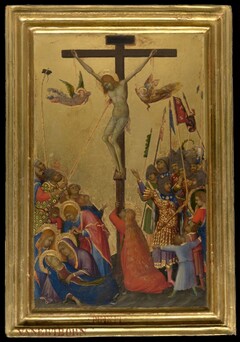 [fig. ane] Simone Martini, Crucifixion (from the Orsini Polyptych), c. 1335, tempera on panel, Purple Museum of Fine Arts, Antwerp
 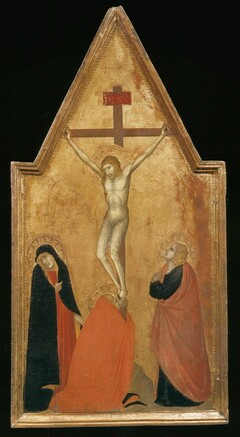 [fig. 2] Pietro Lorenzetti, Crucifixion, c. 1325–1326, tempera on panel, Pinacoteca Nazionale, Siena
This technique was recommended by Cennino Cennini and frequently practiced by Trecento painters. Encounter Cennino Cennini, Il libro dell'arte, ed. Fabio Frezzato (Vicenza, 2003), chap. LXXXV, 127; and Miklós Boskovits in this itemize, entry for Jacopo di Cione's
The putative Neapolitan provenance of the Gallery'south triptych has led several scholars to propose that information technology was producedin situ while the artist was acting equally an emissary to the city.
According to David Alan Dark-brown, a note in the Fototeca Berenson at the Villa I Tatti, Florence, records that the pictures belonged to Count Carlo Zezza, who obtained it from wife, a fellow member of the Naples branch of the Medici family. However, the Zezza provenance is not confirmed. Run into David Alan Dark-brown, "Andrea Vanni in the Corcoran Gallery," in The William A. Corcoran Drove: An Exhibition Mark the 50th Anniversary of the Installation of the Clark Drove at the Corcoran Gallery of Art (Washington, DC, 1978), 36.
Come across Gaetano Milanesi, Documenti per la storia dell'arte senese, 3 vols. (Siena, 1854–1856), one(1854): 295–302; and Scipione Borghesi and Luciano Banchi, Nuovi documenti per la storia dell'arte senese (Siena, 1898), 54–55.
A notable exception is Valerie Linda Wainwright, who dates the triptych to c. 1360–1370. See Valerie Linda Wainwright, Andrea Vanni and Bartolo di Fredi: Sienese Painters in Their Social Context (PhD diss., University of London, University Higher, 1978), 156.
Cf. Andrea Costa, Rammemorazione istorica dell'effigie di Santa Maria di Casaluce (Naples, 1709), 172; Ferdinando Bologna, I pittori alla corte angioina di Napoli, 1266–1414, e united nations riesame dell'arte nell'età fridericiana (Rome, 1969), 325–326; and Enzo Carli, La pittura senese del Trecento (Milan, 1981), 246.
Every bit problematic for the study of the panels is the question of whether they were originally intended to form a portable altarpiece or if they were once office of a larger, stationary
Unlike the lateral panels, the central panel likewise has a slight concave warp which is unusual. As Joanna Dunn has observed, if the panel was repurposed, its former arrangment and function could have induced the warping every bit well every bit account for the punchwork on its reverse. See Dunn's examination report dated December 21, 2015 in the NGA conservation files, where she also mentions the possibility of each side panel originally including ii scenes of equal width.
Joanna Dunn, examination report dated Dec 21, 2015, in the NGA conservation files.
Joanna Dunn, examination report dated Dec 21, 2015, in the NGA conservation files.
If the panels contributed to a stationary polyptych, and so their rectangular shape suggests that they were located along the ensemble's lower register and presumably with other, as of withal unidentified, paintings of Christ'southward Passion. The strongest evidence against this scenario lies in the presence of ornament on the back of the central console. In the later fourteenth century, most big, double-sided altarpieces consisted of split up panels for the front and back.
See Julian Gardner, "Fronts and Backs: Setting and Structure," in La pittura nel XIV due east 15 secolo, il contributo dell'analisi tecnica alla storia dell'arte, eds. Hendrik W. van Os and J. R. J. van Asperen de Boer (Bologna, 1983), 297–322.
Amongst the various works attributed to Vanni or his followers, 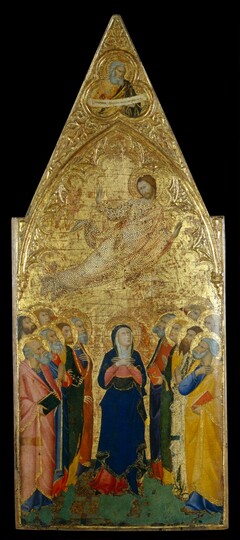 [fig. 3] Andrea di Vanni, Ascension, c. 1380s, tempera on panel, The Country Hermitage Museum, St. Petersburg, Gift of the heirs of Count Thou. Due south. Stroganov, 1911
 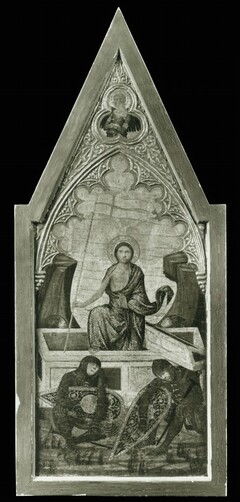 [fig. iv] Andrea di Vanni, Resurrection, c. 1380s, tempera on console, location unknown, formerly in the Ingenheim collection
Bernard Berenson, Italian Pictures of the Renaissance: Cardinal Italian and North Italian Schools, 3 vols. (London, 1968), ane:442. The current location of the Resurrection is unknown. It was sold on July 22, 1981 at the Neumeister, Münchener Kunstauktionhaus, sale 203, lot 749. Other scholars who aspect the Resurrection to Andrea di Vanni include Federico Zeri, "Appunti nell'Ermitage due east nel Museo Pusckin," Bollettino d'arte 46, no. 3 (1961): repro. 221, 225; Ferdinando Bologna, I pittori alla corte angioina di Napoli, 1266–1414, e un riesame dell'arte nell'età fridericiana (Rome, 1969), 325–326; and David Alan Brown, "Andrea Vanni in the Corcoran Gallery," in The William A. Corcoran Collection: An Exhibition Marker the 50th Anniversary of the Installation of the Clark Collection at the Corcoran Gallery of Art (Washington, DC, 1978), 34. The Ascension one time belonged to Count Gregory Stroganoff in Rome and has been variously attributed to Andrea, to 1 of his followers, and to Bartolo di Fredi. Cf. Antonio Muñoz, Pièces de choix de la collection du Comte Grégoire Stroganoff à Rome, 2 vols. (Rome, 1912), ii: 11; Raimond van Marle, The Development of the Italian Schools of Painting, vol. 2, The Sienese Schoolhouse of the 14th Century (The Hague, 1924), 504–505 northward. one; Bernard Berenson, "Quadri senza casa. Il Trecento senese, 1," Dedalo eleven (1930–1931): 274; Millard Meiss, Painting in Florence and Siena Later the Black Death (Princeton, 1951), 31; Viktor Nikitič Lazarev, Proischoždenie italʹjanskogo vozroždenija, vol. 2, Iskusstvo trečento (Moscow, 1959), 289–290, northward. 283; Zeri (1961): repro. 221, 223–226; and Svetlana Vsevolozhskaya and Albert Kostenevich, The Hermitage: Italian Paintings (Leningrad, 1984), 227.
Federico Zeri, "Appunti nell'Ermitage e nel Museo Pusckin," Bollettino d'arte 46, no. 3 (1961): 223–226.
Laurence Kanter has suggested that the ex-Ingenheim and Hermitage panels are from an entirely dissimilar flow in the artist's career. Communicated in an email dated October 21, 2015, in the NGA curatorial files.
Since information technology was start published, the triptych has been considered the artist's only remaining signed work.
F. Mason Perkins, "A Triptych by Andrea Vanni," Fine art in America nine (1921): 186.
For the inscription on Lippo's painting see Michael Mallory, "Thoughts Apropos the Master of the Glorification of St. Thomas," The Art Bulletin 57 (1975): 17 n. 26; and Bonnie Apgar Bennett, Lippo Memmi, Simone Martini'southward "fratello in arte": The Paradigm Revealed by His Documented Works (PhD diss., University of Pittsburgh, 1977), 17, 105–107, 124 north. 21.
What is beyond speculation is the supremely high quality of the triptych. The deep, saturated hues of cherry, yellow, and blue create rhythmic alternations of color that play confronting the gold backgrounds and halos to animate the scenes. Such dazzling effects are carried over into the patterns decorating the soldiers' armor and the mantle of the Pharisee in the Crucifixion scene, equally well as Christ's garment in the Descent into Limbo, which are executed in sgraffito, a technique that mimics the furnishings of brocade by scraping abroad areas of paint laid over gold leaf and tooled with patterned punches. The elaborate costumes bring together the carefully diversified facial features and body movements to communicate the narrative in a concise but vivid manner. Andrea di Vanni is frequently regarded as lacking the skill and sophistication of his great predecessors, but the refined execution, counterbalanced arrangement of complex iconographic elements, and compelling depiction of human emotion that characterize the Gallery's triptych should prompt a revision of his stature.
Jason Di Resta
March 21, 2016
Source: https://www.nga.gov/collection/art-object-page.206072.html
Posted by: butleradaines.blogspot.com
0 Response to "How To Add A Second Fredi Camera"
Post a Comment