

Sodium Hydroxide And Perchloric Acid
In this experiment students neutralise sodium hydroxide with hydrochloric acid to produce the soluble salt sodium chloride in solution. They then concentrate the solution and allow it to crystallise to produce sodium chloride crystals
You have to decide if this experiment is suitable to utilise with dissimilar classes, and look at the need for preliminary training in using techniques involved in titration (see Teaching notes). What follows here assumes that teachers accept judged the grade to be capable of doing this experiment using a burette with reasonable expectation of success.
Assuming that the students have been given training, the practical piece of work should, if possible, first with the apparatus set at each work place in the laboratory. This is to avoid vulnerable and expensive glassware (the burette) beingness collected from an overcrowded fundamental location.

Time required
Phase 1
Filling the burette, measuring out the brine into the flask, and titrating information technology until it is neutralised takes nigh 20 minutes, with false starts being likely for many groups. In practise information technology does not matter if the end-point is overshot, even by several cubic centimetres, but the aim is to observe the proportions for a roughly neutral solution.
Phase 2
Producing a neutral solution complimentary of indicator, should have no more x minutes.
Stage 3
Evaporating the solution may take the rest of the lesson to the point at which the solution tin can be left to crystallise for the next lesson. Watching solutions evaporate can be tedious for students, and they may demand another task to go along them occupied – eg rinsing and draining the burettes with purified h2o.
Equipment
Apparatus
- Center protection
- Burette, xxx or 50 cm3 (notation 1)
- Conical flask, 100 cm3
- Beaker, 100 cm3
- Pipette, 20 or 25 cm3, with pipette filter
- Stirring rod
- Pocket-sized (filter) funnel, near 4 cm bore
- Burette stand and clench (note 2)
- White tile (optional; notation iii)
- Bunsen burner
- Tripod
- Pipeclay triangle (note four)
- Evaporating basin, at least fifty cm3 chapters
- Crystallising dish (note five)
- Microscope or manus lens suitable for examining crystals in the crystallising dish
Appliance notes
- If your school still uses burettes with drinking glass stopcocks, consult the CLEAPSS Laboratory Handbook, section 10.10.1, for their intendance and maintenance. This experiment volition not exist successful if the burettes used have stiff, blocked or leaky stopcocks. Modern burettes with PTFE stopcocks are much easier to apply, crave no greasing, and do not get blocked. Burettes with pinchcocks of whatsoever blazon are not recommended; while cheap, they as well are prone to leakage, peculiarly in the easily of student beginners.
- Burette stands and clamps are designed to prevent crushing of the burette by over-tightening, which may happen if standard jaw clamps are used.
- The optional white tile is to go nether the titration flask, merely white newspaper can be used instead.
- Ceramic gauzes tin can exist used instead of pipeclay triangles, simply the evaporation then takes longer.
- The evaporation and crystallisation stages may be incomplete in the lesson time. The crystallisation dishes need to be set bated for crystallisation to take identify slowly. All the same, the dishes should not exist immune to dry out out completely, as this spoils the quality of the crystals. With occasional checks, it should be possible to decide when to decant surplus solution from each dish to leave good crystals for the students to inspect in the following.
Chemicals
- Sodium hydroxide solution, 0.iv M (IRRITANT), well-nigh 100 cm3 in a labelled and stoppered bottle
- Dilute hydrochloric acrid, 0.4 M, almost 100 cmiii in a labelled and stoppered bottle
- Methyl orange indicator solution (or culling) in pocket-size dropper bottle
Health, safety and technical notes
- Read our standard health and safety guidance.
- Wear eye protection throughout.
- Sodium hydroxide solution, NaOH(aq), (IRRITANT at concentration used) – meet CLEAPSS Hazcard HC091a and CLEAPSS Recipe Book RB085. The concentration of the solution does not demand to be made up to a high degree of accurateness, but should be reasonably close to the same concentration as the dilute hydrochloric acrid, and less than 0.5 Grand.
- Dilute hydrochloric acid, HCl(aq) – see CLEAPSS Hazcard HC047a and CLEAPSS Recipe Book RB043. The concentration of the solution does non need to exist made upwardly to a high degree of accuracy, simply should be reasonably shut to the same concentration every bit the sodium hydroxide solution, and less than 0.5 K.
- Methyl orange indicator solution (the solid is TOXIC only non the solution) – run across CLEAPSS Hazcard HC032 and CLEAPSS Recipe Volume RB000.
Process
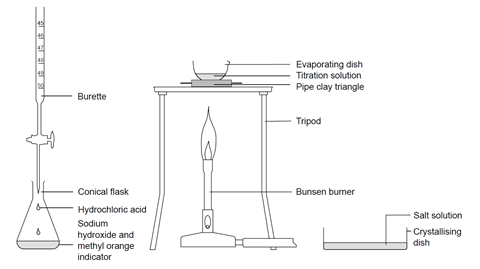
Phase 1
- Using a small funnel, pour a few cubic centimetres of 0.4 One thousand muriatic acid into the burette, with the tap open and a beaker under the open tap. Once the tip of the burette is full of solution, close the tap and add more than solution up to the null mark. (Practice not reuse the acid in the beaker – this should be rinsed down the sink.)
- Use a pipette with pipette filler to transfer 25 (or 20) cmiii of 0.4 Chiliad sodium hydroxide solution to the conical flask, and add 2 drops of methyl orange indicator. Swirl gently to mix. Place the flask on a white tile or piece of clean white paper nether the burette tap.
- Add the hydrochloric acrid to the sodium hydroxide solution in small volumes, swirling gently after each addition. Continue until the solution just turns from xanthous-orangish to ruby-red and record the reading on the burette at this point. This coloured solution should now exist rinsed down the sink.
Stage 2
- Refill the burette to the nil marking. Carefully add together the same book of fresh hydrochloric acrid as you used in stage 1, pace 3, to another 25 (or twenty) cmthree of sodium hydroxide solution, to produce a neutral solution, but this time without whatever indicator.
Phase 3
- Pour this solution into an evaporating basin. Reduce the volume of the solution to most half by heating on a pipeclay triangle or ceramic gauze over a low to medium Bunsen burner flame. The solution spits near the end and you lot become fewer crystals. Do non boil dry. You may demand to evaporate the solution in, say, 20 cm3 portions to avoid overfilling the evaporating basin. Exercise not attempt to lift the hot basin off the tripod – allow to cool first, and and then pour into a crystallising dish.
- Leave the concentrated solution to evaporate farther in the crystallising dish. This should produce a white crystalline solid in one or two days.
- Examine the crystals under a microscope.
Looking for an culling method?
Check out our practical video on preparing a table salt for a safer method for evaporating the solution, along with technician notes, instructions and a gamble assessment activeness for learners.
Education notes
Titration using a burette, to measure volumes of solution accurately, requires conscientious and organised methods of working, manipulative skills centrolineal to mental concentration, and attention to detail. All of these are of course desirable traits to be developed in students, merely there has to be some degree of bones competence and reliability before using a burette with a course. The experiment is nigh likely to be suited to 14–xvi year old students. This is discussed farther below, but what follows here assumes that you have judged the grade to be capable of doing this experiment using a burette with reasonable expectation of success.
Students need training in using burettes correctly, including how to clamp them securely and fill up them safely. You should consider demonstrating burette technique, and requite students the opportunity to exercise this. In this experiment a pipette is not necessary, as the aim is to neutralise any book of alkali is used, and that can be measured roughly using a measuring cylinder.
It is not the intention here to do quantitative measurements leading to calculations. The aim is to innovate students to the titration technique but to produce a neutral solution.
Alternative indicators y'all tin use include screened methyl orangish (green in alkali, violet in acid) and phenolphthalein (pink in alkali, colourless in acrid).
Leaving the concentrated solutions to crystallise slowly should help to produce larger crystals. The solubility of sodium chloride does not change much with temperature, so simply cooling the solution is unlikely to form crystals.
Under the microscope (if possible, a stereomicroscope is best) you tin can see the cubic nature of the crystals. If crystallisation has occurred in shallow solution, with the crystals merely partly submerged, 'hopper-shaped' crystals may be seen. In these crystals, each cube face becomes a hollow, stepped pyramid shape.
Student questions
Phase one
What substances accept been formed in this reaction? Write a word equation and a symbol equation.
Stage two
Why must you utilise some other 25 cm3 of sodium hydroxide solution, rather than making your crystals from the solution in stage 1?
Stage 3
What shape are the crystals?

Sodium Hydroxide And Perchloric Acid,
Source: https://edu.rsc.org/experiments/titrating-sodium-hydroxide-with-hydrochloric-acid/697.article
Posted by: butleradaines.blogspot.com
0 Response to "Sodium Hydroxide And Perchloric Acid"
Post a Comment